

This One Example Explains Our Low Expectations
Why students fail, and how it's our fault.

Podcast is AI generated, and will make mistakes. Interactive transcript available in the podcast post.
Working with a Head of Maths on our Champions programme last week, we had asked him to produce an initial instructional sequence for the categorical concept of linear equation.

No-one creates a logically faultless sequence first time, that’s not the point. The purpose of the exercise is to show how we can make small tweaks to what is probably a good start, and turn it into a better sequence.
Here was his first sequence (the red font is just for your benefit, so you can quickly see the non-examples.)
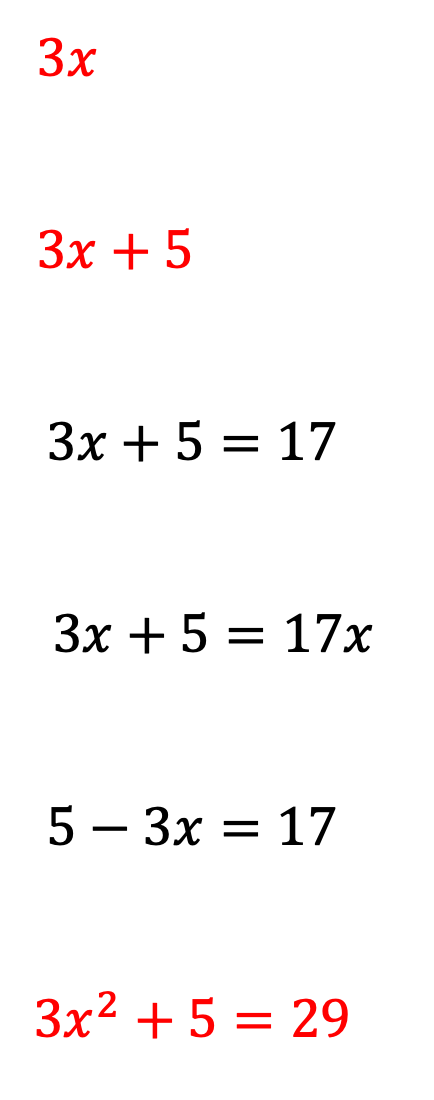
These are the changes we proposed.
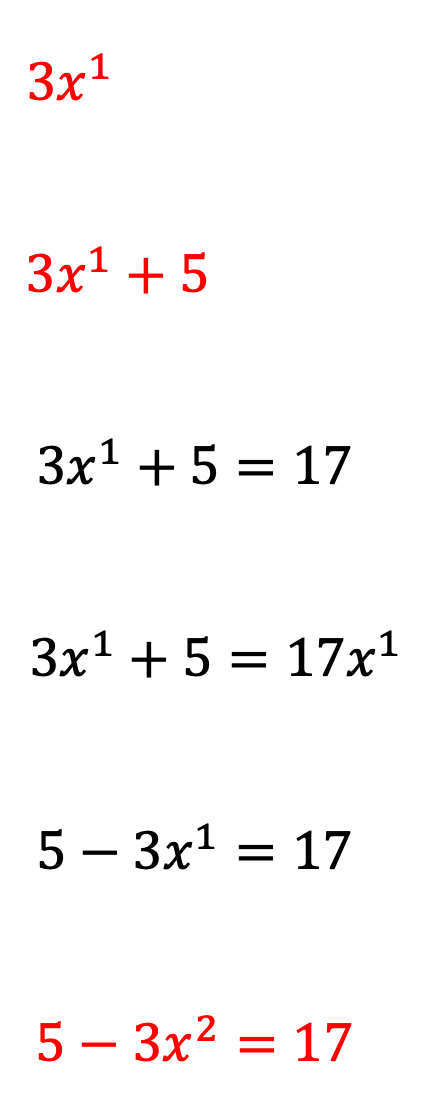
Two small things changed.
First, we revealed the secret 1s in the indices.
This makes it much easier and faster for all students to attend to the features that are going to really matter.
Second, we adjusted the last non-example according to the difference principle, so that it was super clear that the final example was negative because the index of 2 had changed to a 1; that was the only change, and so that’s what discriminates between being linear and non-linear.
Barring that last change in particular, this was an excellent first attempt, and our small tweaks turned it into an even better sequence.
Then, I spotted a problem.
I had missed it at first.
A logically faultless communication is one where there is one, and only one, interpretation that is logically consistent with the presentation.
In my new sequence there were two possible interpretations.
Two.
Not one.
I’ve since put this in front of quite a few very experienced teachers, heads of departments, and trust directors. I give them as long as they like. We are, of course, in a very calm and safe environment.
So far, not one of them has seen the problem.
So now, picture you’re in the heat of the moment, the middle of a live lesson, with the active attention of some thirty students on you; not a lot of time to think, even less likely you’ll see it.
If you present this sequence to your class, and what happens?
Interpretation 1: they learn the features of a linear equation correctly.
Interpretation 2: they fall for the second interpretation, and form a misconception.
Which is more likely?
Here’s the thing: all things being equal, each interpretation is equally likely. There is no reason a student will select the correct interpretation, the one you intended, other than chance. Some prior knowledge, homeschooling, tutoring might help them, but even raw intelligence won’t help here because the second, incorrect, interpretation is perfectly logically consistent with the presentation.
For a moment, let’s imagine the scenario where 29 out of 30 students all ‘get it right,’ they learn what you intended. One doesn’t.
So now, you can’t see anything wrong with what you just showed them, and literally everyone else got it right… whose fault is it that child 30 got it wrong?
Really, how can it be your fault? The sequence looks great, and everyone else got it right.
So, you know what, probably they weren’t paying attention. If they were, they would have learnt it like everyone else.
Or… well, you won’t say it out loud; you might not even dare to think it too consciously, but, maybe they’re just not really smart enough to learn this? Maybe they’d be better off in a different programme, where things are less abstract, and they will get more support?
And yet, they just learnt from what you presented. Their misconception is entirely logically consistent with what you presented.
It was never their fault. Nothing wrong with them. Nothing wrong with their brain. It was just random chance, and a communication that was less than logically faultless.
We just needed to make one more, very small adjustment to the sequence, and 100% of students would have succeeded.
I’ve been speaking about this misconception abstractly.
We’ll take a look at it in a moment, so if you haven’t seen it already and want another chance to try, give it a go now, before reading further.
We’ll also see the sequence that we designed in-house, which we think is also a level up.
